

The Great Himalayan Ultra 2026
Leh → Nyoma → Leh → Domkhar → Leh · 600 km, Solo Crew Supported
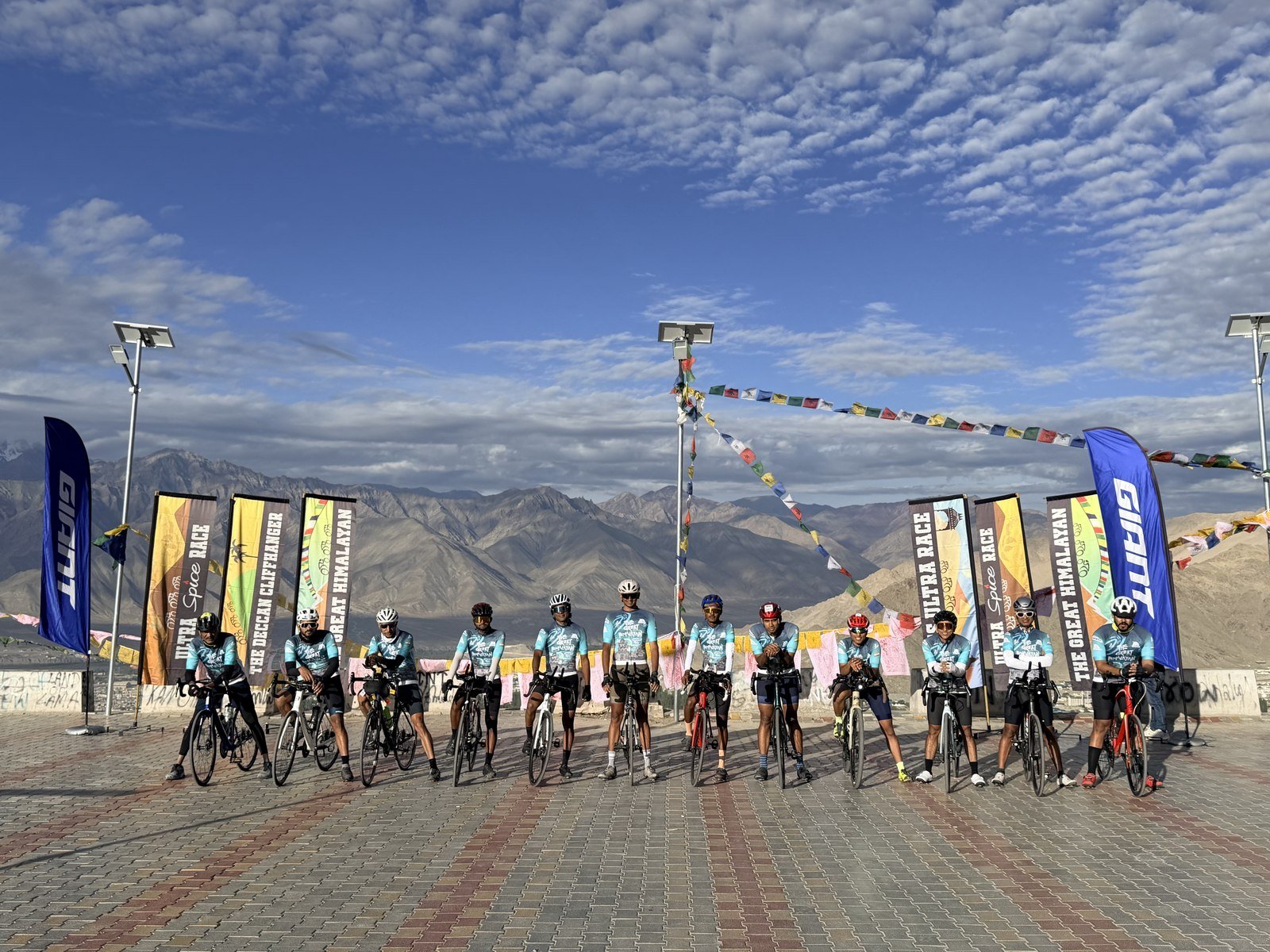
Solo, crew-supported, across the roof of the world — Bharat Pannu won the 600 km Solo Crew Supported category at the 8th edition of The Great Himalayan Ultra, Ladakh’s brutal high-altitude RAAM qualifier, in a racing time of 30 hours 36 minutes.
The Great Himalayan Ultra is organised by Inspire India out of Leh, Ladakh, and billed by the organisers as the world’s highest-altitude ultracycling race — starting and finishing at an elevation of 3,500 m (11,500 ft). Bharat had originally registered for the Self-Supported 600 km category before requesting, ahead of the race, a switch to Solo Crew Supported — racing with a dedicated support crew rather than carrying everything himself. The 8th edition ran over 22–23 August 2026, Inspire India’s 29th event overall.
Day 1: Leh → Upshi → Kiari → Nyoma (turn point) → back to Leh for a night halt and a mandatory 3-hour break.
Day 2: Leh → Sangam → Khaltse → Domkhar (turn point) → back to Leh for the finish at Ruthpa Homestay.
- 0.0 kmLeh GateStart — flagged off 6:00 AM, Saturday 22 Aug 2026
- 109.3 kmKiari — Indus CafeOutbound checkpoint on the Sindhu (Indus) valley — 444 km field turns back here
- 183.0 kmNyoma — TURN POINTIndian Oil Petrol Pump, RQ cut-off 6:30 PM
- 256.8 kmKiari — Indus CafeReturn leg, self check-in
- 369.4 kmLeh — Ruthpa HomestayEnd of Day 1 — mandatory 3-hour break, latest restart 10:00 AM Day 2
- 485.3 kmDomkhar — TURN POINTBlue Bridge, via Sangam and Khaltse on the Indus highway toward Srinagar
- 601.2 kmLeh — Ruthpa Homestay — FINISHFinished in 33h 36m elapsed · 30h 36m racing time
Distances and checkpoint timings per the official Inspire India Rules & Regulations and Control Point schedule. The 600 km Solo Crew Supported category (Men 18–49) carried a 37-hour RAAM Qualification cut-off on racing time and a 40-hour cut-off on total elapsed time, including the mandatory 3-hour halt.
Day 1 — to Nyoma and back. All sixteen starters across the 444 km and 600 km fields were flagged off from Leh Gate at 6:00 AM on 22 August. Bharat held with the early leaders through the narrow Sindhu valley to the checkpoint at Kiari (109.3 km), then continued into the wider, thinly populated valley toward Nyoma — a stretch that stays continuously above 4,000 m, shared with yaks, Tibetan wild ass and black-necked cranes, and with almost no resources along the way. He turned at Nyoma (183.0 km) roughly an hour behind race leader Ajinkya Bodke and just ahead of his sole rival in the Crew Supported field, Prarabdh Awasthi, then retraced the route back through Kiari (256.8 km) to Ruthpa Homestay in Leh (369.4 km) to close out Day 1, where all 600 km racers take a mandatory three-hour recovery break before continuing.
Day 2 — to Domkhar and the finish. After the break, Bharat was among the first riders back on the road, out along the Indus highway through Khaltse to the Day 2 turn point at Domkhar (485.3 km) and back to Leh. He crossed the finish line at Ruthpa Homestay (601.2 km) in a total elapsed time of 33 hours 36 minutes — 30 hours 36 minutes of net racing time once the mandatory break is excluded, well inside his category’s 37-hour RAAM Qualification cut-off — to take first place in the 600 km Solo Crew Supported category. His only rival in the category, Prarabdh Awasthi, had abandoned with illness after Day 1. The result RAAM-qualified him for a start at the Race Across America and, per the race organisers, made him the first rider to RAAM-qualify on the podium at every Inspire India race he has entered.
The Great Himalayan Ultra is organised by Inspire India and run out of Leh, Ladakh — by the organisers’ own description, the world’s highest-altitude ultracycling race, starting and finishing at an elevation of 3,500 m (11,500 ft). It is one of Inspire India’s marquee RAAM qualifiers, held during the short late-summer window of stable Ladakh weather. Every 600 km and 444 km racer must report in Leh for mandatory acclimatisation at least ten days before the start, and every 600 km crew member at least five days before — a rule the race applies strictly given how quickly altitude sickness can turn dangerous above 3,500 m.
The event runs Solo Self-Supported and Solo Crew Supported formats at 444 km and 600 km, under cut-off times that scale with category and age — 40 hours for Bharat’s 600 km Crew Supported, 18–49 category. The 2026 edition was the race’s 8th, and Inspire India’s 29th event overall: sixteen riders started, including one entrant from Italy, with thirteen finishing across both distances.
Inspired to ride further?
Coaching cyclists of every level one-on-one on TrainingPeaks, with fortnightly personal interactions and daily WhatsApp support for issues.